
Agam Kuan, the bottomless well, is an ancient relic of the Mauryan Emperor Ashok. located a little distance away from Ashoka's Charitable Hospital in the Kumrahar complex, Patna is this famous Ashokan remain, the Agam Kuan, which is believed to be a part of the legendary hall created by Ashoka.
Fa Hein relates that Ashoka, in course of his distant journeys had encountered the kingdom of Yama and accordingly thought of building a hall, resembling the one he had seen there. Later, Ashoka demolished the hall and embarked on projects of compassion and goodness
The two Buddha stupas in Vaishali Bihar are dedicated to lord Buddha were unearthed here that are said to contain sacred ashes.
Buddha Stupa 1
Sacred ashes were found enshrined in a casket here. The external of this stupa, which is now in a decaying condition, has a plain surface. One eighth of the sacred ashes of the lord Buddha were enshrined here in a stone casket.
Buddha Stupa 2
Excavated in 1958, it too, contains sacred ashes. Excavations at this site in 1958 led to the discovery of another casket containing the ashes of the Lord Buddha.
Facing the Vaishali Museum is the good-looking lake known as the Coronation Tank or Abhishekh Pushkarni. Surrounded by flowering trees and shrubs, the water of the reservoir was assumed to be holy in the older days and all of Vaishali's selected representatives were anointed here, before their swearing in.
Built on the south bank of the coronation tank is the Vishwa Shanti Stupa (pillar of peace), which is a major desirability in Vaishali. This monument is one of the uppermost in the world and has been built in collaboration with the Japanese government.
Other places of interest near the Coronation Tank are Chaumukhi Mahadeva, Harikatora Temple, Lotus Temple and Miranji-Ki-Dargah.
Fort Vishal, one kilometer lengthy fort is said to have housed the parliament of those times. This fort is named after King Vishal. The fort was a element of the oldest democracy in the world. The construction of this fort is worth giving a look. Apart from the fort, the museum of Vaishali is worth visiting.
This museum has some of the excavated artifacts from Vaishali. Then there are the Stupas, Abhishek Pushkarni and the Dargah of Miran ji are some of the tourist places in Vaishali. The stupas found in Vaishali had stone caskets which contained the ashes of Budha. About the Abhishek Pushkarni is said that a king anoint with the water of this tank before his coronation.
Golghar is one of the most outstanding architectural members of the British India. It, in a way, symbolizes the identity of Patna. It is build close to the Ganga in Bankipur locality of Patna. Captain John Garstin, an engineer employed by the East India Company, has the credit of its conception and construction. It was built in the year 1786. It was built at the request of the then proprietor, Warren Hastings. Bihar experienced severe draught that resulted in acute food shortage in the year 1770. Alarmed by the condition faced by the people, this massive granary was constructed for the British army.
A flight of steps winds round this 29m high building to the top from where one gets a fine view of the river Ganga and Patna city.
Overlooking the river and the plains, it looks like the upper half of a gigantic, decorated Easter egg, with the spiral stairway winding around this monument, adding to its embellishment. It offers a magnificent breathtaking view of the city and the river Ganges, flowing nearby.
The twisting staircase was so designed, in order to make easy the passage of the coolies, who had to carry grain-bags up one flight, deliver their load through a hole at the top, and descend the other stairs.
The purpose of this huge circular structure with an imposing dome was to store grains in huge quantity. The impetus of its construction was the famine of 1770. But perhaps it was never put to this noble purpose.
Though it was one of the important buildings built by the British Engineer in British India, it has nothing Greeco-Roman with it. It, on the contrary, was inspired by the native Stupa architecture of the ancient Indian tradition. Raised on a 2' high plinth, the enormous dome, over a circular plan, raises well up to 96'. It creates a wonderful echo effect from inside. The walls, all brick masoned, with its width of 12'-4", are no less impressive. Two spiraling stairways, rising from the opposing sides, reach to the top, which has a small hole at the centre (2'-7"). The doors at the bottom of the dome, are placed on all the four cardinal directions, which opened originally from within. Two inscriptions, one in English and the other in Persian rendering are affixed adjacent to each other giving information about its construction.
Lauriya (district Champaran) contains, besides an inscribed Asokan Pillar, fifteen stupa-mounds. Four of them were excavated in 1904-07 and as two of them yielded a put down of burnt bones with charcoal and a gold leaf with a mother-goddess shape (akin to the one from Piprahwa), they were regarded by the excavator to be vedic burial tumuli.
As an answer of their re-examination in 1935-37, they were definitely accepted to be stupas of mud or mud-bricks with baked-brick revetments (in two cases with actual brick-lining). They were regarded as roughly current with the Piprahwa Stupa on account of the analogous find of the mother-goddess shape on the gold leaf.
Nandangarh, about 2 km, from the Asokan Pillar, represents a fortified habitation-site. At one end of the site was excavated a big brick stupa, reared up on multiple polygonal terraces with numerous re-entrant angles. This edifice, of the early on centuries A.D., is the earliest example of a form of terraced stupa, which culminated in the celebrated monuments of Paharpur in East Pakistan and Borobudur in Java, both dating from circa A.D. 800.
Life-size statues in front of the aged secretariat compound have been put up in memory of seven brave young men who faced bullets for the freedom of the country and sacrificed their lives in August 1942 in the historic struggle for India's independence during "Quit India" movement.
It is a modern sculpture with life dimension statues of the seven martyrs', in front of the Secretariat where they were shot in their attempt to hoist the national tricolor.
The most famed and essential of the monuments at Munger is the fort, build on a rocky eminence projecting into the river Ganga which protects it from west and partly from the north, the extra sides being defended by a deep moat. the fort encloses an region of about 222 acres and has a route of 4 kms. It was construct during the time of the early, Mohammedan kings of India.
Raj Mahal is located on the eastern tassel of Bihar, on the western bank of river Ganga, Raja Maan Singh, the well-known 16th century Rajput common in Akbar's army, founded this city.
The Sangi Dalan built on river bank, is a part of the place of shah shuja, son of Shah Jehan. was built in 1556 to allow emperor Akbar to pray. Jami Masjid - Raj Mahal was built by Raja maan Singh in a combination of the Imperial and Bengal styles. There are number of other monuments in town.
Rohtasgarh Fort 39 kms from Sasaram are the remains of Sher Shah Suri's Rohtasgarh fort, It now occupies a part of the plateau about 4 miles east to west and 5 miles north to south, 28 miles in circumference.
Rohtasgarh Fort is considered one of the major and strongest hill forts in India. this fort served as a safe shelter for treasures and families of Sher Shah Suri, Shah Jahan, maan singh, Mir Qasim (and others during the revolt of 185). Records propose that there are 84 passages to the hill with 14 main gates entry. However Sher Shah Closed ten of them.
Vikramshila situated 252 kms from Patna, in the district of Bhagalpur, is the site of an ancient University, Vikramshila. The university was founded by king Dharmpala, in late 8th century AD. After prosperous for years, it was plundered by invaders around 1200 AD.
Vikramshila University belongs to the Pala period and thus can be assigned to the period between 10th and 12th centuries A.D. The site covers a very extensive area dotted with carved pillars, votive stupas and mounds with remains.
Famous for studies in Tantra, it also bore the imprint of teachings in Buddhism. Close by are the Rajmahal Hills and Pathar Ghat, famous for their Jurassic Age rocks and natural fossils. This place is ideal for Eco-Tourism development.
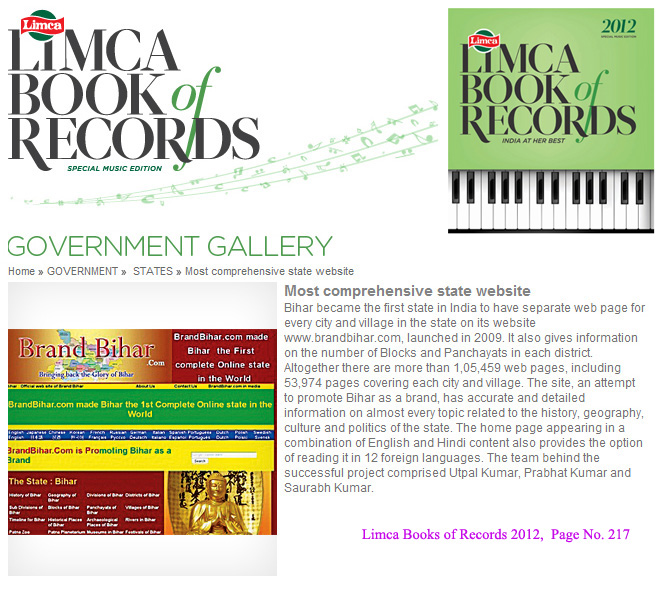
Bihar became the first state in India to have separate web page for every city and village in the state on its website www.brandbihar.com (Now www.brandbharat.com)
See the record in Limca Book of Records 2012 on Page No. 217